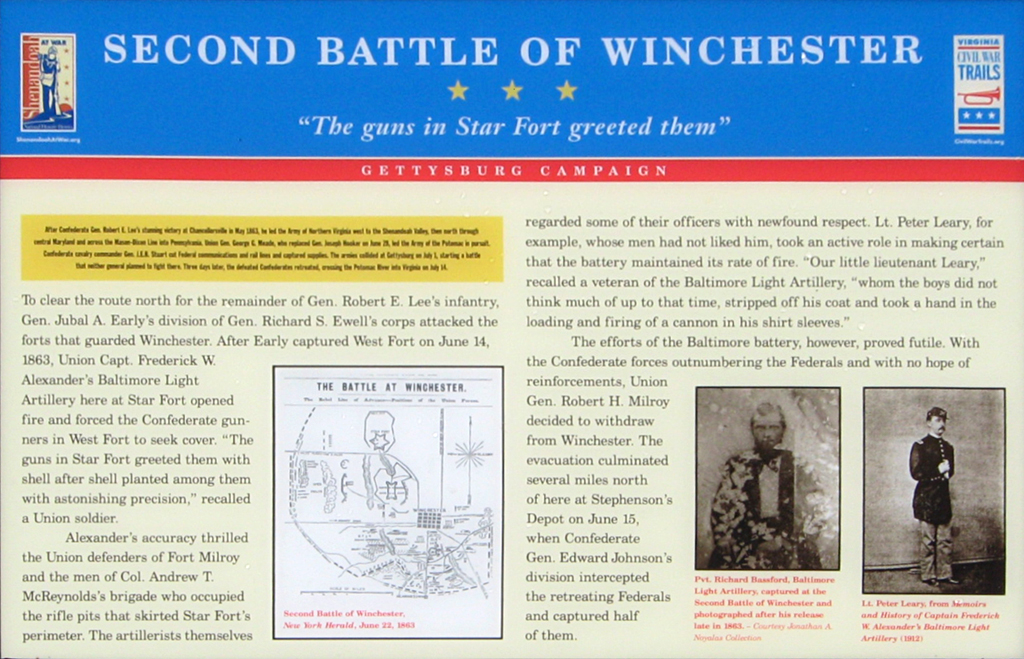
The Second Battle of Winchester – “The guns in Star Fort greeted them” wayside marker was at Star Fort on the northwest side of Winchester, Virginia. The marker was removed in 2024 but is shown here for archival reasons.

Text from the marker:
The Second Battle of Winchester
“The guns in Star Fort greeted them”
Gettysburg Campaign
To clear the route north for the remainder of Gen. Robert E. Lee’s infantry, Gen. Jubal A. Early’s division of Gen. Richard S. Ewell’s corps attacked the forts that guarded Winchester. After Early captured West Fort on June 14, 1863, Union Capt. Frederick W. Alexander’s Baltimore Light Artillery here at Star Fort opened fire and forced the Confederate gunners in West Fort to seek cover. “The guns in Star Fort greeted them with shell after shell planted among them with astonishing precision,” recalled a Union soldier.
Alexander’s accuracy thrilled the Union defenders of Fort Milroy and the men of Col. Andrew T. McReynolds’s brigade who occupied the rifle pits that skirted Star Fort’s perimeter. The artillerists themselves regarded some of their officers with newfound respect. Lt. Peter Leary, for example, whose men had not liked him, took an active role in making certain that the battery maintained its rate of fire. “Our little lieutenant Leary,” recalled a veteran of the Baltimore Light Artillery, “whom the boys did not think much of up to that time, stripped off his coat and took a hand in the loading and firing of a cannon in his shirt sleeves.”
The efforts of the Baltimore battery, however, proved futile. With the Confederate forces outnumbering the Federals and with no hope of reinforcements, Union Gen. Robert H. Milroy decided to withdraw from Winchester. The evacuation culminated several miles north of here at Stephenson’s Depot on June 15, when Confederate Gen. Edward Johnson’s division intercepted the retreating Federals and captured half of them.
Text from the sidebar at top left:
After Confederate Gen. Robert E. Lee’s stunning victory at Chancellorsville in May 1863, he led the Army of Northern Virginia west to the Shenandoah Valley, then north through central Maryland and across the Mason-Dixon Line into Pennsylvania. Union Gen. George G. Meade, who replaced Gen. Joseph Hooker on June 28, led the Army of the Potomac in pursuit. Confederate cavalry commander Gen. J.E.B. Stuart cut Federal communications and rail lines and captured supplies. The armies collided at Gettysburg on July 1, starting a battle that neither general planned to fight there. Three days later, the defeated Confederates retreated, crossing the Potomac River into Virginia on July 14.
Caption to the map:
Second Battle of Winchester, New York Herald, June 22, 1863
Caption to the photo on the left:
Pvt. Richard Bassford, Baltimore Light Artillery, captured at the Second Battle of Winchester and photographed after his release late in 1863. – Courtesy Jonathan A. Noyalas Collection
Caption to the photo on the right:
Lt. Peter Leary, from Memoirs and History of Captain Frederick W. Alexander’s Baltimore Light Artillery (1912)