
Overview of the Romney Expedition – January, 1861
Background
At the end of 1861 Thomas Jackson was assigned to command of the Valley District. He was threatened from the north by Union forces in Hapers Ferry and along the Potomac, and from the west by forces in what is now West Virginia but which was at the time still part of Virginia.
The terrain of the Valley favored the Confederacy. The Valley itself ranged roughly from the southwest to the northeast. Travel along the Valley was relatively easy, with the Valley Turnpike stretching the length of the Valley. Entering or exiting the Valley from the east or west was more difficult. Steep ranges of mountains, the Blue Ridge on the east and the Allegheny Mountains on the west, offered only a few exit and entry points. Crossing the Valley at its northern end was the Potomac River, which was unnavigable but could only be crossed in a few locations. Paralleling the Potomac were the Chesapeake & Ohio Canal and the Baltimore & Ohio Railroad. Both would be critical transportation routes from the Midwest to the Washington-Baltimore area for the entire Civil War.
Confederate Objectives
Jackson’s goal was to clear his district of the Union troops that occupied the part of the Valley around the Potomac River and to the west. He also hoped to recapture all of Union-held western Virginia by moving west along the Potomac River.
Union Objectives
Federal commanders were from two different departments with little coordination between them. Major General Nathaniel P. Banks was part of the Department of the Potomac, and his orders were to protect the canal and railroad on the north end of the Valley and to prevent Confederate raids across the Potomac. Brigadier General William Rosecrans commanded the Department of Western Virginia and had ideas about advancing from his base at Romney and capturing Winchester, which would threaten the main Confederate army at Manassas Junction. But McClellan did not approve, and transferred many of Rosecrans’ troops away, killing his plan.
Confederate Forces
Jackson began the campaign with three brigades of militia augmented by Jackson’s former Brigade, veterans of the Battle of Manassas. He also had an oversized regiment of cavalry under Lieutenant Colonel Turner Ashby and four batteries of artillery. At the end of December he was reinforced by Loring’s Army of the Northwest, a division sized organization of three brigades. With Loring, Jackson commanded about 11,000 men. (see organization)
Union Forces
Union Major General Nathaniel P. Banks commanded a division of around 8-10,000 men deployed along the Potomac River. Brigadier General Benjamin F. Kelley commanded about 5,000 men at Romney. About 1,500 men were posted to Hancock, Maryland, with an advanced post across the Potomac at Bath.
Results of the Romney Expedition
Jackson succeeded in temporarily removing Union troops from Virginia soil in the northern part of the Valley, and in preventing a Union advance on Winchester from the west. But his severe winter weather put an end to his plans of continuing on to Cumberland, and the dream of reclaiming all of Western Virginia would never come to pass. Even the capture of Romney as a western outpost for Winchester was negated by Loring’s actions which forced Jackson to order him to abandon it.
Timeline of the Romney Expedition
|
November 1861
|
||
| November 4 | 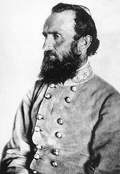 Confederate Major General Thomas J. Jackson was assigned command of the newly created Valley District. He made his headquarters at WInchester, Virginia. Jackson took command of three brigades of militia. Concerned at the lack of training and experience of his men, Jackson requested some veterans from Johnston’s army at Manassas. He was hoping he would be sent his old brigade. Confederate Major General Thomas J. Jackson was assigned command of the newly created Valley District. He made his headquarters at WInchester, Virginia. Jackson took command of three brigades of militia. Concerned at the lack of training and experience of his men, Jackson requested some veterans from Johnston’s army at Manassas. He was hoping he would be sent his old brigade. |
|
| November 9 | Over Johnston’s objections, Jackson was sent his old Stonewall Brigade from Johnston’s army at Manassas as reinforcements. They took the train from Manassas to Strasburg, then marched north to Winchester. | |
| November 11 | When ordered to bivouac in the rain south of Winchester, about half the Stonewall Brigade deserted to make their way to warm beds in the city. | |
| November 20 | Concerned at Federal positions to the west that flanked his position in the Valley and hoping to keep the Federals off balance by taking the initiative, Jackson proposed an expedition to Romney. The proposal was approved. | |
|
December
|
||
| December 8 | Jackson was reinforced at Winchester with Taliaferro’s Brigade of Loring’s Division. Loring’s Division, known as the Army of the Northwest, numbered around 6,000 men. | |
| December 16-21 | Jackson marched north, leading the Stonewall Brigade, Rockbridge Artillery and Carson’s militia on a raid against Dam No. 5 on the Potomac River before returning to Winchester. | |
| December 25 | The remainder of Loring’s Division, consisting of Anderson’s and Gilham’s Brigades, reached Staunton. | |
|
January 1862
|
||
| January 1 |
The Romney ExpeditionJackson marched northwest out of Winchester in unseasonably warm weather with 9,000 men. That night temperatures plummeted and a brutal bllizzard began, covering the road with a sheet of ice. |
|
| January 3 | Jackson’s men reached Bath and skirmished with Union forces outside the town. | |
| January 4 | Union troops pulled out of Bath. Jackson passed through the town and reached the Potomac River across from Hancock, Maryland, which was defended by a Union garrison. Jackson briefly shelled the town. Union Brigadier General Frederick Lander arrived to take command. | |
| January 5-6 |
Battle of HancockThe temperature reached zero and stayed there for the rest of the battle, with wind chills far below. Lander refused to surrender, and Jackson shelled the town for two days while looking for a good river crossing. He destroyed a section of the Baltimore & Ohio Railroad, which ran along the south side of the Potomac. |
|
| January 7 | Unable to find a crossing, Jackson withdrew south. He learned that Union forces had withdrawn from a skirmish at Blue’s Gap toward Romney. Thinking that Union forces at Romney were a threat to Winchester, he decided to capture the town | |
| January 10 | Learning that Jackson with his superior numbers were on the way, Union forces under Benjamin Kelley withdrew from Romney. | |
| January 15 | Jackson occupied Romney. | |
| January 24 | Jackson cancelled his plans to move on Cumberland, Maryland due to how badly the severe winter weather had affected his men. He left Loring’s division in Romney and marched the Stonewall Brigade and Ashby’s cavalry to Winchester. Richard Ewell was promoted to major general. | |
| January 30 |
Loring’s Petition and Jackson’s ResignationA petition from the officers of Loring’s Division was sent without Jackson’s knowledge to Secretary of War Benjamin. Benjamin ordered Jackson to remove Loring’s Division from Romney. Jackson complied with the order. He then resigned, asking to be returned to the Virginia Military Institute, where he had been a professor before the war: “Your order requiring me to direct General Loring to return with his command to Winchester immediately has been received and promptly complied with. With such interference in my command I cannot expect to be of much service in the field, and accordingly respectfully request to be ordered to report for duty to the superintendent of the Virginia Military Institute at Lexington, as has been done in the case of other professors. Should this application not be granted, I respectfully request that the President will accept my resignation from the Army.” |
|
|
February
|
||
| February 7 | Union forces reoccupied Romney, negating the benefit of the campaign | |
| February 9 | Jackson was persuaded to withdraw his resignation. He then filed court-martial charges against Loring.
But instead of holding the court martial, charges against Loring were dropped. Loring was promoted and reassigned to southwestern Virginia and his division was broken up. Jackson was given all of Loring’s Virginia troops – 6 regiments and three batteries, around 4,000 men – while Loring’s non-Virginia troops were transferred from Jackson’s command. |
|
| February 24-26 | Union Major General Nathaniel Banks crossed the Potomac and moved south towards Winchester. The Shenandoah Valley Campaign of 1862 began. | |