
Two Virginia Historical Markers and one Wayside Marker tell more of the story of the Confederate hospital at Mount Jackson.
“Mt. Jackson General Hospital, CSA” current wayside marker
The marker was erected in 2024 by Civil War Trails. It replaced a very similar marker from 20120, which is included below for historical purposes. It is across the street from the Our Soldiers Cemetery and next to the “A66 The Confederate Hospital” Virginia historical marker (see below).
Text from the current marker:
Mt. Jackson General Hospital, CSA
“Many dying on our hands”
In September 1861, the Confederate Medical Department built a large general hospital on this site to care for sick and wounded southern soldiers. It was located here because Mt. Jackson was the western terminus of the Manassas Gap Railroad, which facilitated transportation from northern Virginia battlefields. The hospital consisted of three two-story buildings, each “150 feet in length, perfectly ventilated, and yet warm,” and several small support structures, and could accommodate 500 patients.
Dr. Andrew Russell Meem, a Shenandoah County resident, was Surgeon-in-Charge. He resided at Harrison House, the home of local businessman Col. Levi Rinker, who owned the hospital site and a plot across the Valley Turnpike where “Our Soldiers’ Cemetery” was established to bury those who died here. Meem, two assistant surgeons (contract physicians), five stewards, ten nurses, eight cooks, and five laundresses comprised the staff.
The Union army occasionally took over the hospital, including after the Battle of New Market when Federal surgeons worked into the night, with, one remembered, “many mortally wounded dying on our hands.”
After the U.S. Army dismantled the hospital and used the lumber to build a military installation at Rude’s Hill. The installation included a courthouse, guardhouse, ballroom, and gallows.
In February 1865, after falling ill, Meem was admitted to Harrisonburg General Hospital where he died at age 41. His wife, Ann Jordan Meem, had assisted him at the Mt. Jackson Hospital, and in October 1861 organized the Ladies’ Soldiers Relief and Aid Association to provide clothing, food, and supplies. The Association held one of the earliest Confederate Memorial Day services at “Our Soldiers’ Cemetery” on May 15, 1866.
“Mt. Jackson General Hospital, CSA” original wayside marker
The original marker was erected in 2010 by Civil War Trails.

Text from the marker:
Mt. Jackson General Hospital, CSA
Shenandoah at War
— Valley Campaigns —
In September 1861, the Confederate Medical Department built a large general hospital on this site because Mt. Jackson was the western terminus of the Manassas Gap Railroad which provided access to northern Virginia battlefields. Dr. Andrew Russell Meem, a Shenandoah County resident who was a graduate of Princeton University and the University of Pennsylvania Medical College, was Surgeon-in-Charge. He resided at Harrison House, the home of local businessman Col. Levi Rinker, who owned the hospital site and a plot across the Valley Turnpike, “Our Soldiers’ Cemetery,” to bury those who died here.
The hospital consisted of three two-story buildings, each “a hundred and fifty feet in length, perfectly ventilated, and yet warm,” and several small support structures. Accommodating 500 sick and wounded Confederates at a time, it remained in continuous service until the end of hostilities, except for six months in 1862. Meem, two assistant surgeons (contract physicians), five stewards, ten nurses, eight cooks, and five laundresses comprised the staff. The buildings were dismantled aft the war for the use of U.S. Army forces stationed at Rude’s Hill during Reconstruction.
In February 1865, after falling ill, Meem was admitted to Harrisonburg General Hospital where he died at age 41. His wife, Ann Jordan Meem, had assisted him at the the Mt. Jackson hospital and in October 1861 organized the Ladies’ Soldiers and Aid Organization to provide clothing, food and supplies. The Association held one of the earliest Confederate Memorial Day services at “Our Soldiers’ Cemetery” on May 15, 1866.

Confederate surgeon’s kit used in the Shenandoah Valley.
Courtesy Virginia Military Institute

Closeups of two insets from the marker:
Mt. Jackson General Hospital, Oct. 7, 1864, by James E. Taylor, artist for Frank Leslie’s Illustrated – and –
Order appointing Dr. Andrew H. Meem Surgeon-in-Charge, Mt. Jackson General Hospital.
Our Soldiers’ Cemetery A65 Virginia historical marker
The marker is just outside the gates of the Civil War Our Soldiers’ Cemetery along with its monuments To All Confederates and to The Confederate Hospital, and across the street from The Confederate Hospital Virginia historical marker (below) and the Mt. Jackson General Hospital wayside marker (above).
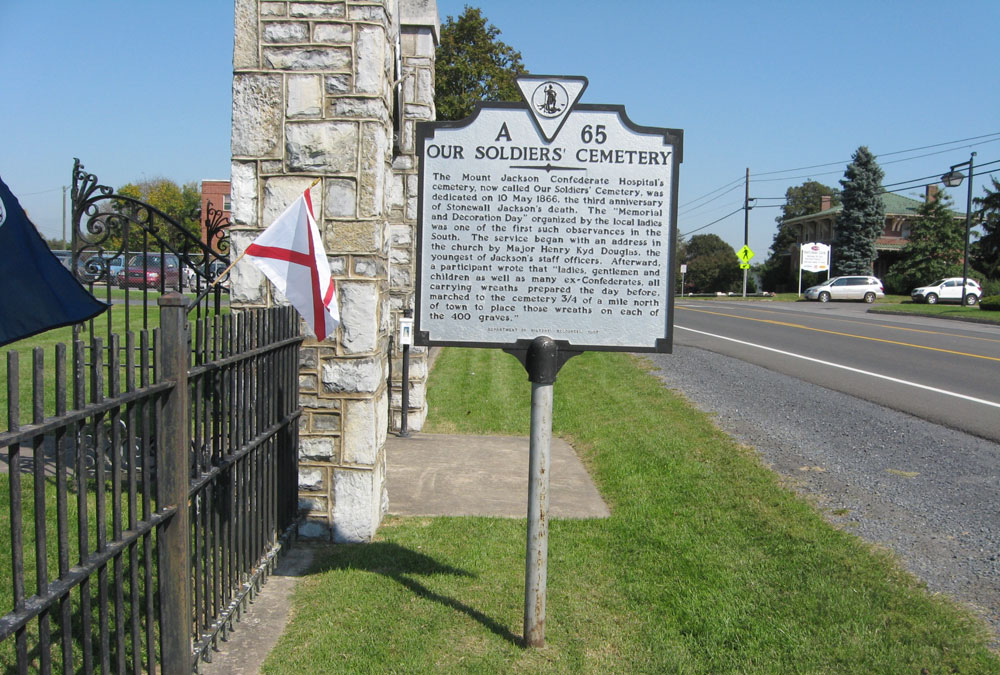
Text from the marker:
A65
Our Soldiers’ Cemetery
The Mount Jackson Confederate Hospital’s
Cemetery, now called Our Soldiers Cemetery, was
dedicated on May 10, 1866 the third anniversary
of Stonewall Jackson’s death. The “Memorial
and Decoration Day” organized by the local ladies
was one of the first such observances in the
South. The service began with an address in
the church by Major Henry Kyd Douglas, the
youngest of Jackson’s staff officers. Afterward,
a participant wrote that “ladies, gentlemen and
children as well as many ex-Confederates, all
carrying wreaths prepared the day before,
marched to the cemetery ¾ of a mile north
of town to place those wreaths on each of
the 400 graves.”
Erected 1997 by the Department of Historic Resources.
Confederate Hospital A66 Virginia historical marker
The marker across the street from the Our Soldiers Cemetery and next to the Mt. Jackson General Hospital, CSA wayside marker (above). A bronze bas-relief of the hospital as it appeared during the war is beside the marker. It is a duplicate of one that is on the Monument to the Confederate Hospital across the street.

Text from the marker:
A66
The Confederate Hospital
The Confederate hospital was built here under
the direction of Dr. Andrew Russell Meem, by
order of the Confederate Medical Department in
Sept. 1861. The hospital consisted of three two-story
buildings, each 150 feet long, accommodating 500
patients. At the end of the war, the 192nd Ohio
Volunteer Militia tore down the hospital and
used the lumber to construct a large military
installation that included a courthouse, guardhouse,
gallows, and ballroom on Rude’s Hill, three miles
south of Mount Jackson. Federal ocupation
forces used these structures throughout the
Reconstruction period. The cemetery, which was
established directly across the Valley Pike in
1861, was dedicated in 1866.
Erected 1998 by the Department of Historic Resources.

Location of the markers
The Civil War Our Soldiers’ Cemetery, its monument and historical markers are on the north side of Mount Jackson, on the the west side of the Valley Pike (U.S. 11) about 0.4 mille south of Mount Jackson Road. (38°45’17.3″N 78°38’02.7″W)