
Chantilly Main Page * Battle of Chantilly * Ox Hill Battlefield Park * The Armies
The final part of the Ox Hill Battlefield Park Interpretive Trail passes by two more wayside markers before returning to the Information Kiosks and parking area. Both markers were erected in 2008 by the Fairfax County Park Authority.
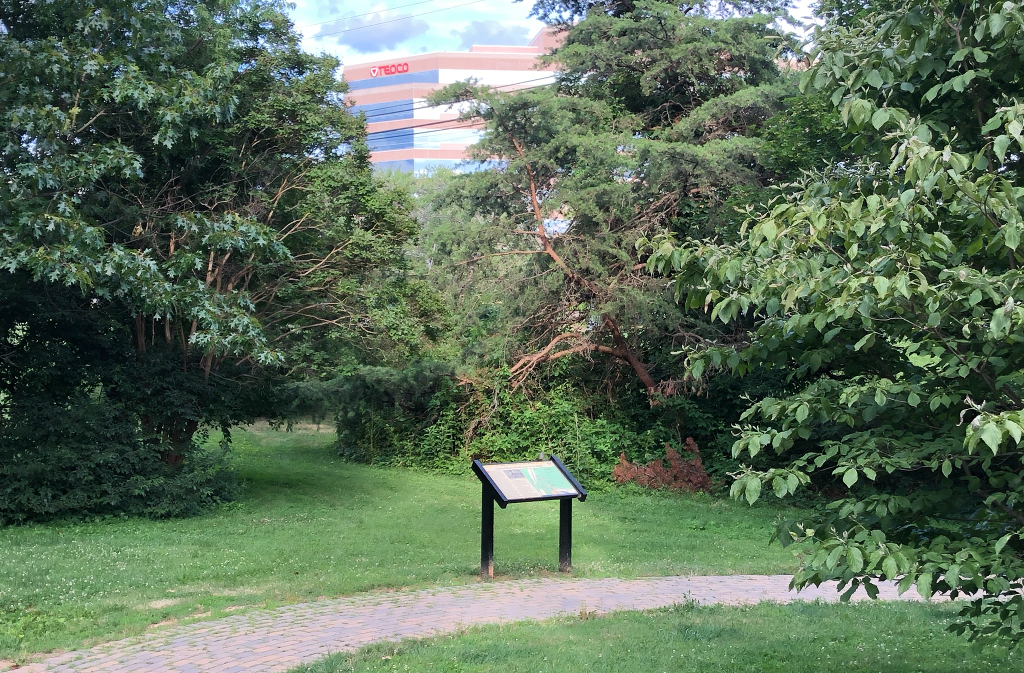
General Reno’s Probe East of Ox Road wayside marker
Stop number 8. Location 38° 51.883′ N, 77° 22.252′ W.
General Reno’s Probe East of Ox Road
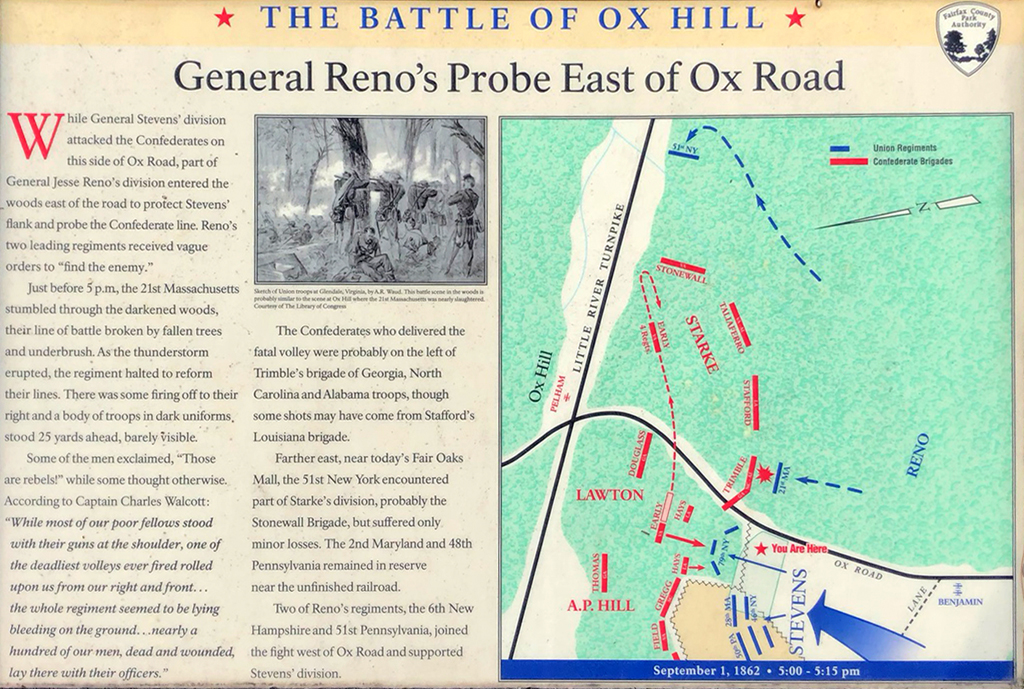
While General Stevens’ division attacked the Confederates on this side of Ox Road, part of General Jesse Reno’s division entered the woods east of the road to protect Stevens’ flank and probe the Confederate line. Reno’s two leading regiments received vague orders to “find the enemy.”
Just before 5 p.m., the 21st Massachusetts stumbled through the darkened woods, their line of battle broken by fallen trees and underbrush. As the thunderstorm erupted, the regiment halted to reform their lines. There was some firing off to their right and a body of troops in dark uniforms stood 25 yards ahead, barely visible.
Some of the men exclaimed, “Those are rebels!” while some thought otherwise. According to Captain Charles Walcott: “While most of our poor fellows stood with their guns at the shoulder, one of the deadliest volleys ever fired rolled upon us from our right and front…the whole regiment seemed to be lying bleeding on the ground…nearly a hundred of our men, dead and wounded, lay there with their officers.”
The Confederates who delivered the fatal volley were probably on the left of Trimble’s brigade of Georgia, North Carolina and Alabama troops, though some shots may have come from Stafford’s Louisiana brigade.
Farther east, near today’s Fair Oaks Mall, the 51st New York encountered part of Starke’s division, probably the Stonewall Brigade, but suffered only minor losses. The 2nd Maryland and 48th Pennsylvania remained in reserve near the unfinished railroad.
Two of Reno’s regiments, the 6th New Hampshire and 51st Pennsylvania, joined the fight west of Ox Road and supported Stevens’ division.
Captions to photographs:
Gen David B. Birney, USA and Gen. Lawrence O’Bryan Branch, CSA
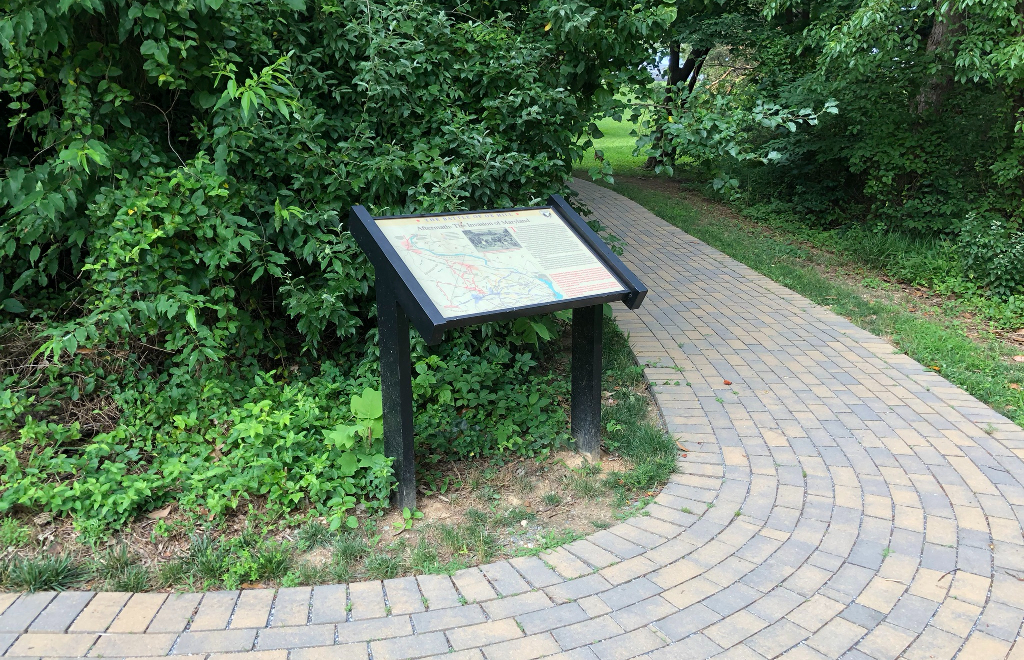
Aftermath: the Invasion of Maryland wayside marker
Stop number 9. Location 38° 51.864′ N, 77° 22.175′ W.
Aftermath: the Invasion of Maryland
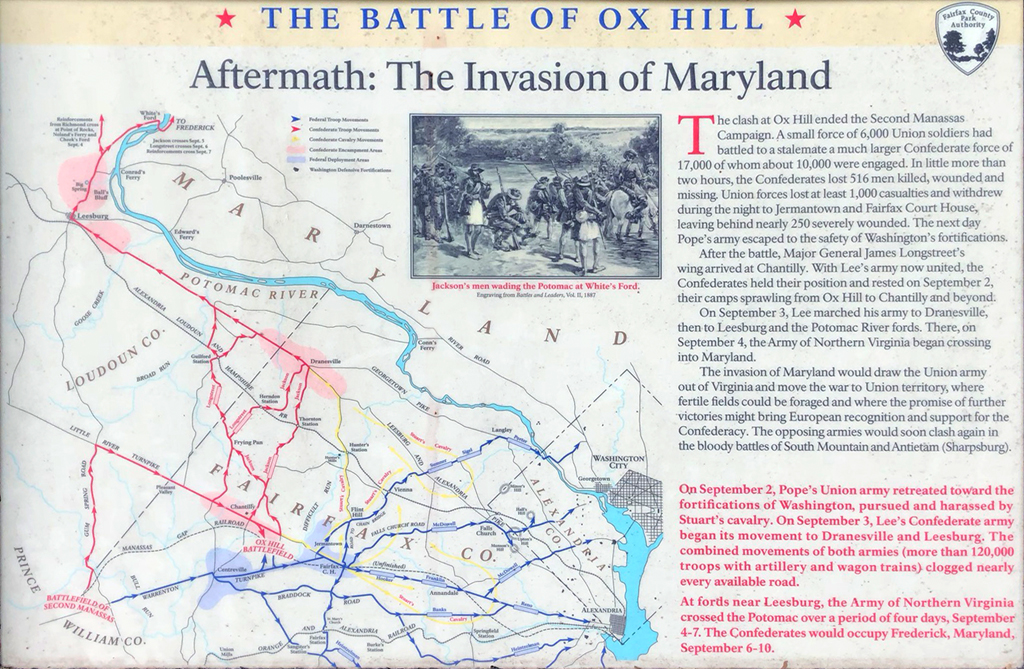
The clash at Ox Hill ended the Second Manassas Campaign. A small force of 6,000 Union soldiers had battled to a stalemate a much larger Confederate force of 17,000 of whom about 10,000 were engaged. In little more than two hours, the Confederates lost 516 men killed, wounded and missing. Union forces lost at least 1,000 casualties and withdrew during the night to Jermantown and Fairfax Court House, leaving behind nearly 250 severely wounded. The next day Pope’s army escaped to the safety of Washington’s fortifications.
After the battle, Major General James Longstreet’s wing arrived at Chantilly. With Lee’s army now united, the Confederates held their position and rested on September 2, their camps sprawling from Ox Hill to Chantilly and beyond.
On September 3, Lee marched his army to Dranesville, then to Leesburg and the Potomac River fords. There, on September 4, the Army of Northern Virginia began crossing into Maryland.
The invasion of Maryland would draw the Union army out of Virginia and move the war to Union territory, where fertile fields could be foraged and where promise of further victories might bring European recognition and support for the Confederacy. The opposing armies would soon clash again in the bloody battles of South Mountain and Antietam (Sharpsburg).
Caption to the map:
On September 2, Pope’s Union army retreated toward the fortifications of Washington, pursued and harassed by Stuart’s cavalry. On September 3, Lee’s Confederate army began its movement to Dranesville and Leesburg. The combined movements of both armies (more than 120,000 troops with artillery and wagon trains) clogged nearly every available road.
At fords near Leesburg, the Army of Northern Virginia crossed the Potomac over a period of four days, September 4-7. The Confederates would occupy Frederick, Maryland, September 6-10.
Caption to the photo:
“Jackson’s men wading the Potomac at White’s Ford.” Engraving from Battles and Leaders, Vol. II, 1887.
Next stop:
The trail ends back at the Information Kiosks and Parking area.