
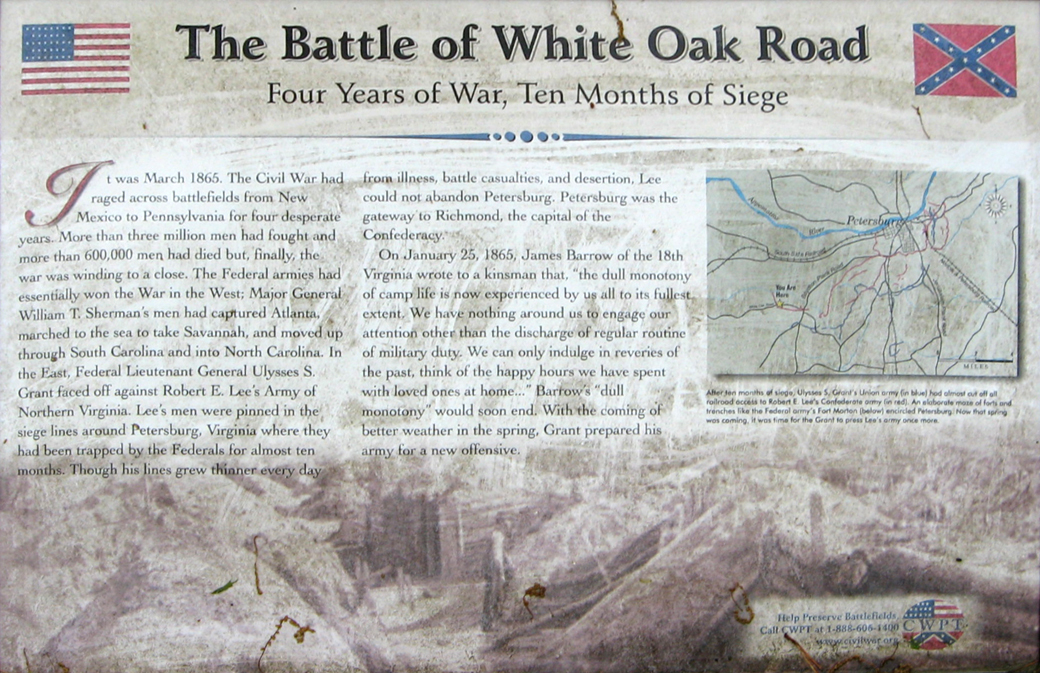
‘Four Years of War, Ten Months of Siege‘ is the first wayside marker along the Civil War Trust’s battlefield trail at White Oak Road. It is at the beginning of the 2/3 mile trail within a few feet of the parking area. The marker was erected by the Civil War Preservation Trust.
‘The Battle of Lewis Farm’ is the next wayside marker along the trail.
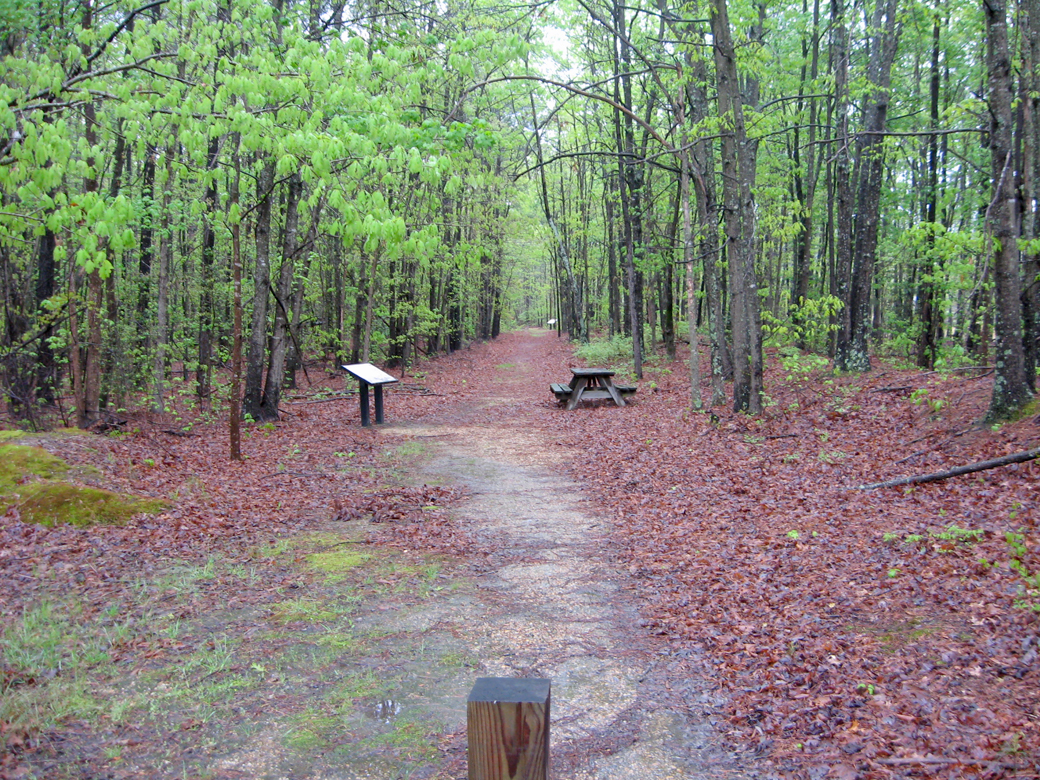
The view looks east from the parking area along the Civil War Trust’s White Oak Road battlefield trail. The ‘Four Years of War, Ten Months of Siege’ wayside marker is on the left, and the ‘Battle of Lewis Farm’ Marker can be seen in the far distance to the right of the trail. The trail parallels White Oak Road, which is on the right on the other side of a narrow band of trees. The slight rise to the right of the trail is the remnant of Confederate defensive works, which the trail follows. The Union attack came from the right, out of the woods on the other side of White Oak Road. The photo was taken in April, not too much later in the year than when the battle was fought.
From the marker:
Four Years of War, Ten Months of Siege
It was March 1865. The Civil War had raged across battlefields from New Mexico to Pennsylvania for four desperate years. More than three million men had fought and more than 600,000 men had died but, finally, the war was winding to a close. The Federal armies had essentially won the War in the West; Major General William T. Sherman’s men had captured Atlanta, marched to the sea to take Savannah, and moved up through South Carolina and into North Carolina. In the East, Federal Lieutenant General Ulysses S. Grant faced off against Robert E. Lee’s Army of Northern Virginia. Lee’s men were pinned in the siege lines around Petersburg, Virginia where they had been trapped by the Federals for almost ten months. Though his lines grew thinner every day from illness, battle casualties, and desertion, Lee could not abandon Petersburg. Petersburg was the gateway to Richmond, and the capital of the Confederacy.
On January 25, 1865, James Barrow of the 18th Virginia wrote to a kinsman that, “the dull monotony of camp life is now experienced by us all to its fullest extent. We have nothing around us to engage our attention other than the discharge of regular routine of military duty. We can only indulge in reveries of the past, think of the happy hours we have spent with loved ones at home…” Barrow’s “dull monotony” would soon end. With the coming of better weather in the spring, Grant prepared his army for a new offensive.
From the caption to the map:
After ten months of siege, Ulysses S. Grant’s Union army (in blue) had almost cut off all railroad access to Robert E. Lee’s Confederate army (in red). An elaborate maze of forts and trenches like the Federal army’s Fort Morton (below) encircled Petersburg. Now that spring was coming, it was time for the Grant [sic]to press Lee’s army once more.
 |
Part of this battlefield
|