
The Third Battle of Winchester “The enemy within the fort… hastily evacuated” wayside marker is at Star Fort on the northwest side of Winchester, Virginia. It was erected by Virginia Civi War Trails.
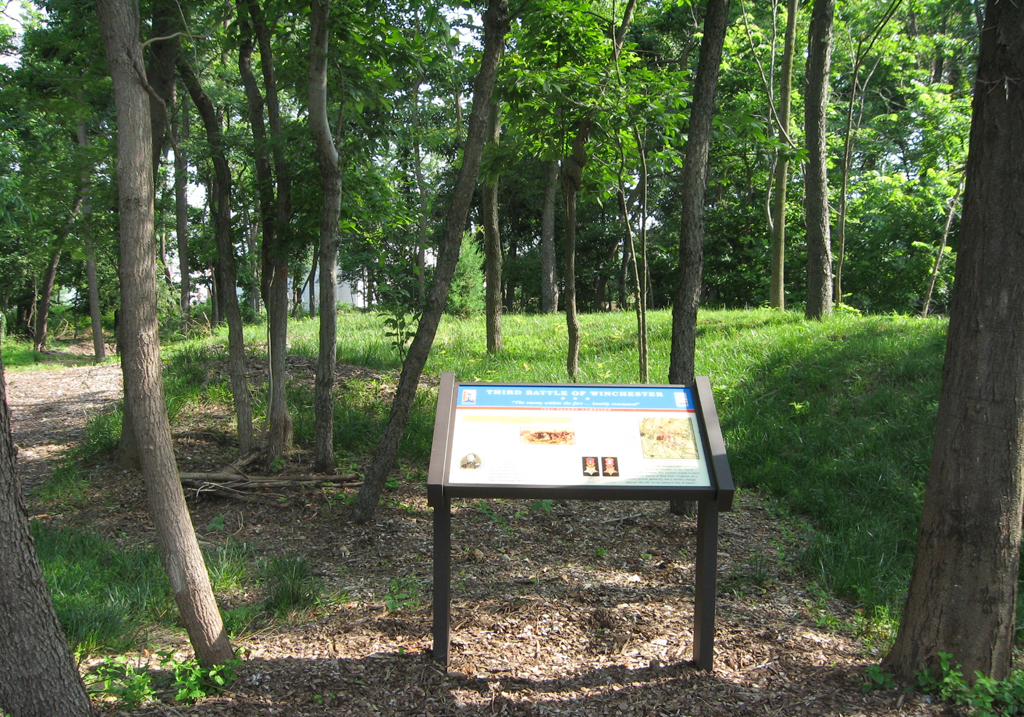
The Third Battle of Winchester
“The enemy within the fort… hastily evacuated”
1864 Valley Campaign
During the Third Battle of Winchester on the afternoon of September 19, 1864, Confederate Gen. Jubal A. Early ordered Col. Thomas T. Munford’s brigade to Star Fort. Here, with two guns of Maj. James Breathed’s Horse Artillery, Munford was to protect Early’s avenue of retreat.
No sooner had the Confederate detachment arrived than Union Col. James M. Schoonmaker’s cavalry brigade charged the defenses and was repulsed. A veteran of the 22nd Pennsylvania Cavalry later wrote, “When we … charged for the entrance of the fort, we received a murderous fire, killing and wounding a number of men… The fort was occupied by a strong force, who swarmed the embankments and poured a hot and continuous fire into our column.” After the charge, Munford noted that “things looked very ugly” as Union guns then shelled the position, compelling him to order the artillery’s withdrawal.
As the Confederate artillery departed, Schoonmaker decided that instead of assaulting the fort from the front, he would move against its left. When the cavalrymen neared the walls, some of them dismounted and stormed the fort on foot. “The enemy within the fort,” recalled a veteran of Schoonmaker’s brigade, “becoming alarmed lest they be flanked and cut off, hastily evacuated.”
On May 19, 1899, Schoonmaker received the Medal of Honor for bravery at the Third Battle of Winchester. His citation stated in part: “During the Battle of Star Fort, Virginia, at a critical period , gallantly led a cavalry charge against the left of the enemy’s line of battle.”
From the sidebar at upper left:
The fertile Shenandoah Valley was the “Breadbasket of the Confederacy” as well as an avenue of invasion. Confederate Gen. Jubal A. Early’s march north and his raid on Washington, D.C., in June-July 1864 alerted Union Gen. Ulysses S. Grant to the threat that Early posed while he held the Valley. In August, Grant sent Gen. Philip H. Sheridan and his Army of the Shenandoah to defeat Early. In several battles between September 19 and October 19—Third Winchester, Fisher’s Hill, Tom’s Brook, and Cedar Creek—Sheridan accomplished his mission and laid waste to much of the Valley in “The Burning.”
From the caption to the photo on the lower left:
Col. James M. Schoonmaker
Courtesy Nicholas Picerno Collection
From the caption to the painting in the center:
Schoonmaker’s Charge
Courtesy Soldiers and Sailors Memorial Hall & Museum
From the caption to the photos at the bottom center:
Schoonmaker’s Medal of Honor, obverse and reverse Courtesy VMI Museum System
From the caption to the map on the right:
Third Battle of Winchester, Lt. Robert K. Sneden Courtesy Library of Congress

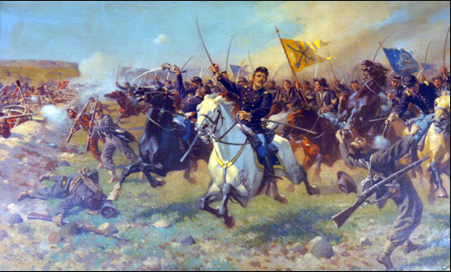
Closeup of Schoonmaker’s Charge