
Battles of Manassas • Tour the Battlefield • Monuments • The Armies
The monument to General Thomas J. Jackson and his horse, Little Sorrel, is on Henry Hill at Manassas, where he earned the nickname “Stonewall”.

Jackson before Manassas
Thomas Jackson was a West Point graduate (USMA class of 1846), a veteran of the Mexican War, and an instructor at Virginia Military Institure. With war developing in April of 1861 Jackson, now a Colonel in the Provisional Army of Virginia, was ordered to Harpers Ferry to take command of the militia units from the Shenandoah Valley that were gathering there. He organized these men into the 2nd, 4th, 5th, 27th, and 33rd Virginia Infantry regiments, drilling them relentlessly. On June 17 of 1861 Jackson was promoted to Brigadier General. The five regiments were designated as the First Brigade of General Joseph E. Johnson’s Army of the Shenandoah.
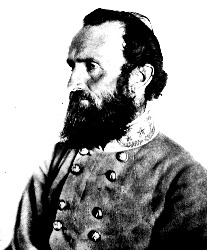
Thomas J, Jackson in 1863
“Stonewall” Jackson at Manassas
Jackson’s Brigade was brought to Manassas by train on July 20. Around noon on July 21, with the Union attack beginning to crumble the Confederate lines, Jackson was ordered forward as support to Henry Hill. Jackson formed his men on the reverse slope of the hill, shielded from enemy fire.
Brigadier General Barnard E. Bee’s South Carolina Brigade had been overwhelmed. Bee rode up to Jackson yelling, “They are beating us back!” Jackson replied, “Then we will give them the bayonet!” Bee rode back to his men and urged them to reform, shouting, “There is Jackson standing like a stone wall. Let us determine to die here, and we will conquer. Rally behind the Virginians!”
Jackson led his brigade forward. The 33rd Virginia overran Griffin’s Union Battery. The 33rd was wearing blue uniforms, and Griffin was ordered not to fire on them. (Blue for Union and Grey for Confederate was not yet well established; there were Union regiments in grey as well, and Jackson himself would continue to wear his old blue U.S. Army uniform until 1862.) Griffin’s support infantry was scattered, and Jackson sent forward two more of his regiments which captured Rickett’s Union battery as well. Federal troops counterattacked, Confederate reinforcements responded, and the battle seesawed across the abandoned guns until Union forces pulled back around 4 o’clock.
Jackson was lightly wounded in one of the fingers of his left hand. After the battle he refused to have it amputated.
About the monument
In 1936 the General Assembly of Virginia appropriated $25,000 to erect the monument. The Virginia Museum of Fine Arts held a sculpture competition for the statue’s design, and New York sculptor Joseph Pollia won the competition. Land was purchased by the Sons of Confederate Veterans. It soon became clear that the cost of upkeep for the land would be a problem. It was transferred to the National Park Service in March of 1938, becoming the core of Manassas National Battlefield Park, which was established on May 10, 1940 . The monument was dedicated by the State of Virginia on August 31, 1940 and unveiled by Julia Preston, Jackson’s Great Granddaughter.
The monument caused a storm of protest – by Confederate organizations. It was criticized for making Jackson seem too old (he was only 39 when he died). And too muscular; some compared him to the recently released Superman comic. Little Sorrel was also criticized as too big; one aging veteran said he looked “more like a buffalo.” No one liked the cape.

Text from the front of the monument:
Jackson
Text from the right side of the monument:
First Battle of Manassas July 21, 1861

Text from the left side of the monument:
There stands Jackson like a stone wall
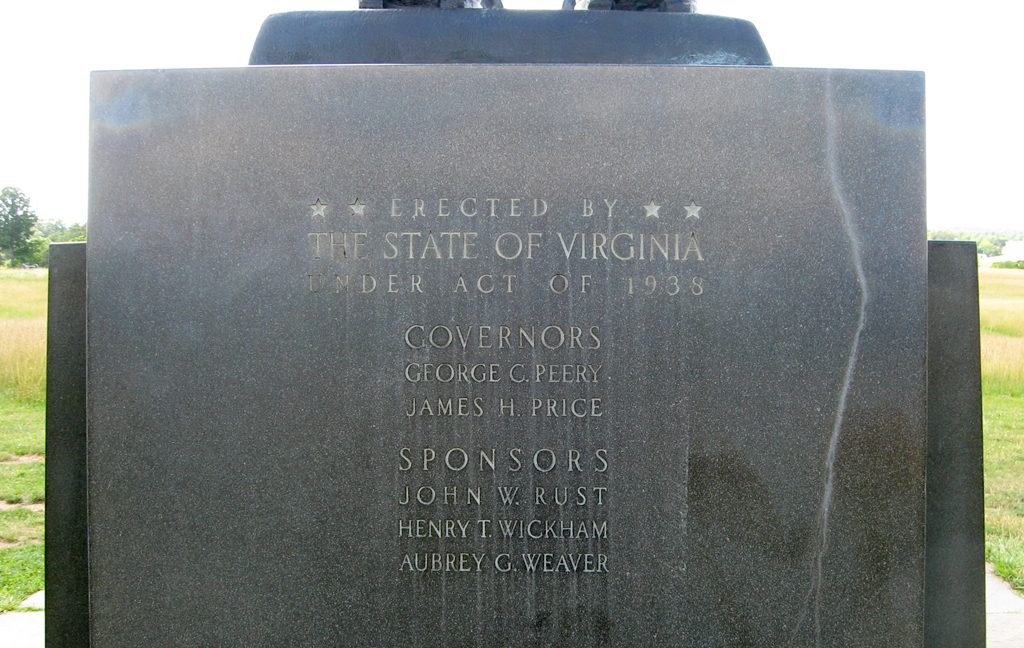
Text from the rear of the monument:
Erected by
The State of Virginia
Under Act of 1938
Governors
George C. Peery
James H. Price
Sponsors
John W. Rust
Henry T. Wickham
Aubrey G. Weaver
Map and directions to the Stonewall Jackson monument
The monument is at the Henry Hill Visitor Center at Manassas Battlefield Park. It is along a trail about 400 feet northeast of the building.