
Battles of Manassas • Tour the Battlefield • Monuments • Facts • The Armies
The Robinson House wayside marker is on the Henry Hill walking tour. The Robinson House was rebuilt in the 1920s, and burned in 1993.
Note: The marker has been updated. The text of both versions is shown for historical reference.
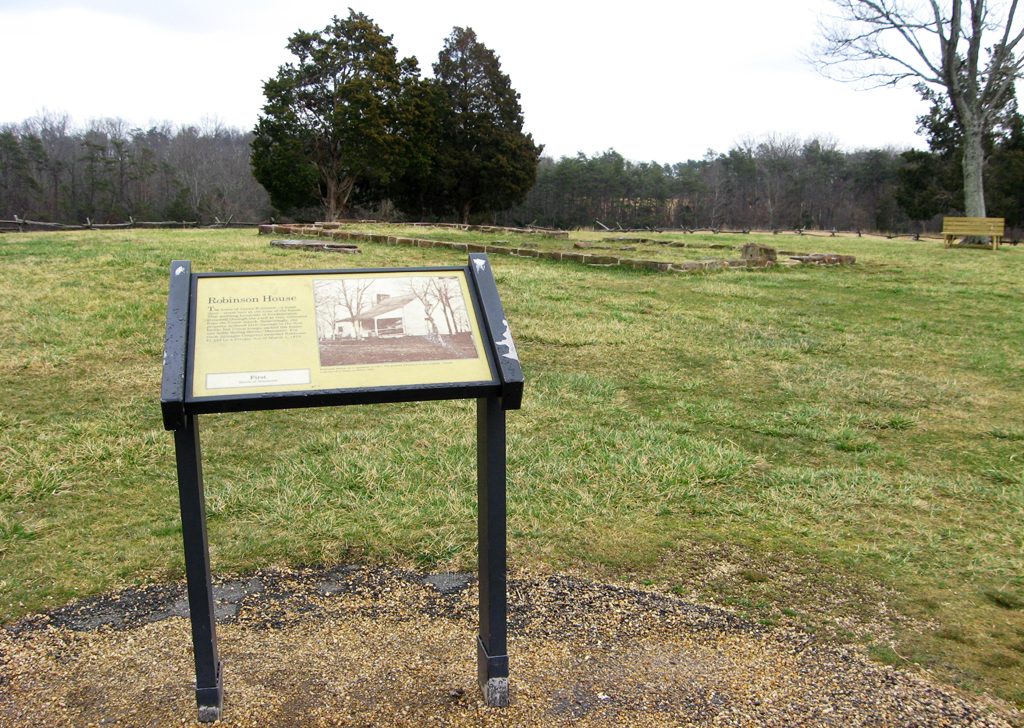
Text from the current wayside marker:
Robinson House
The home of James Robinson—a freed slave—stood here at the time of the battle. That morning hundreds of Confederates streamed through the yard as they retreated from the Union attach. Surprisingly, the property suffered little damage in the first battle, but Union troops sacked the house and fields during Second Manassas. For these damages Congress awarded Robinson $1,249 by Private Act of March 3, 1873.
First
Battle of Manassas
From the caption to the photo:
Robinson House, as it appeared in 1861. The present structure is not original, though a section of it dates to 1888.

Text from the original wayside marker:
Robinson House
Here stood the home of James Robinson and his family. Born “free” in 1799, James is listed as being of mixed racial parentage. Family oral history suggests that James’ father was possibly a member of the Carter family of Pittsylvania plantation. In 1840, James purchased 170 acres of land on Henry Hill. Within a decade, he had built a modest one-and-one-half story log dwelling and assorted outbuildings. Robinson was the third wealthiest free black man living in Prince William County prior to the war.
Nine family members, spanning three generations, resided here in 1860. During the First Battle of Manassas, the family took refuge in a neighbor’s cellar, and James reportedly hid under the turnpike bridge over Young’s Branch. Despite its location amidst the fighting, the house escaped major damage. The farm remained safely behind Union lines through most of the Second Battle of Manassas, although General Franz Sigel established his headquarters on the property.
In 1872, Robinson submitted a claim to the government to recover some of the financial loss incurred during the war. He claimed that $2,608 of personal property was either taken or destroyed by Union soldiers — including large quantities of hay, wheat, corn, livestock, fence rails, and assorted furniture. Robinson was reimbursed for $1,249, less than half of what he claimed.
Photo by George Barnard, March 1862
Location of the marker
The marker is on the Henry Hill Loop Trail, about 0.4 mile from the Visitor Center travelling counter clockwise, 0.5 going clockwise.