
Pamplin Park • Breakthrough Trail • Tudor Hall • Fortifications • Markers • Timeline
The Breakthrough Battefield near Petersburg, Virginia is where the Siege of Petersburg ended. After nine months of Grant edging his way around Lee’s thinning defensive lines, Union troops broke through on the morning of April 2, 1865. By evening Richmond was being evacuated and Lee’s army was marching west. In seven days Grant caught up at Appomattox Court House.
Pamplin Historical Park is a private park which preserves 424 acres of the Petersburg Breakthrough battle of April 2, 1865.
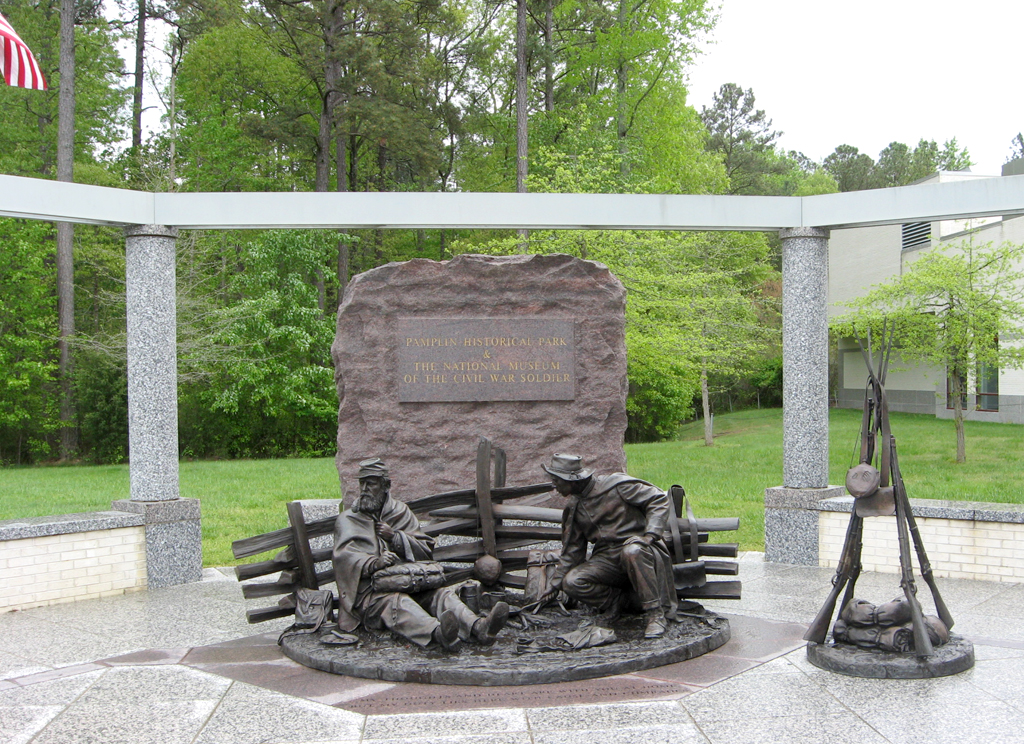
Monument at the entrance to the National Museum of the Civil War Soldier at Pamplin Historical Park
History of the park
Pamplin Historical Park was established in 1993 by businessman and Civil War enthusiast Robert B. Pamplin, Jr. The park is a U.S. National Historic Landmark, a Virginia Historic Landmark, and is on the National Register of Historic Places. The National Museum of the Civil War Soldier was created in 1999.
What’s at Pamplin Historic Park
The National Museum of the Civil War Soldier, with an an audio tour and an interactive gallery of over 700 artifacts.
The Breakthrough Trail includes three self guided walking trails through well preserved fieldworks from the battle, with interpretive markers and monuments.
Tudor Hall Plantation is a restoration of historic plantation buildings with displays of crops and livestock.
Fortifications Exhibit and military encampments.
Monuments & Markers lists the monuments and historical markers that help tell the story of the battlefield, with links to their pages which include photos, text, and map locations.
Timeline shows the progression of the nine month Siege of Petersburg, with links to important battles and events along the way.
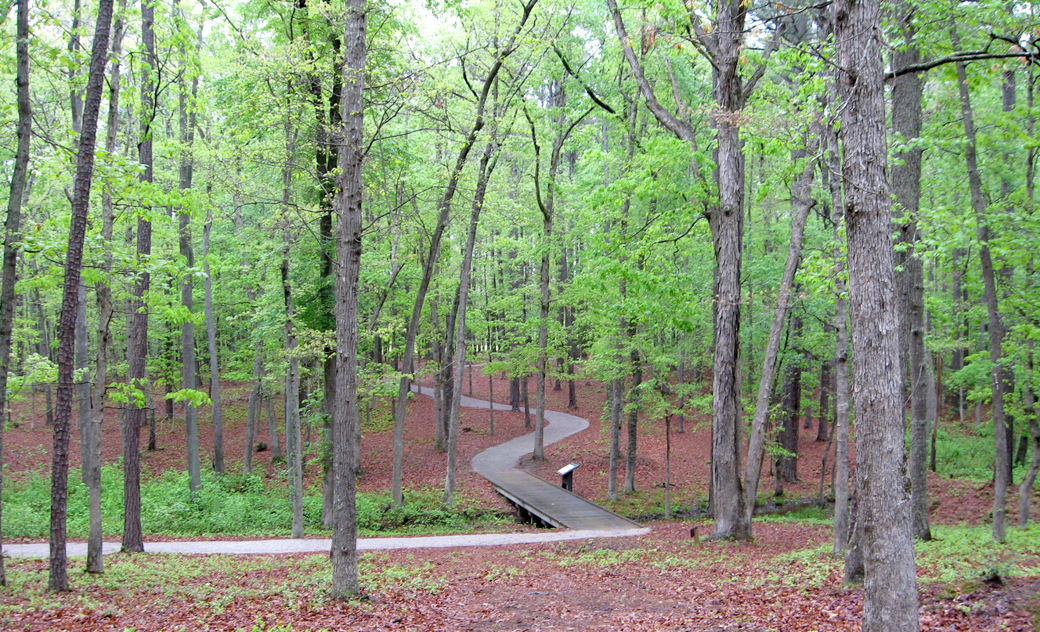
Wayside markers along the trail interpret events from the fighting.
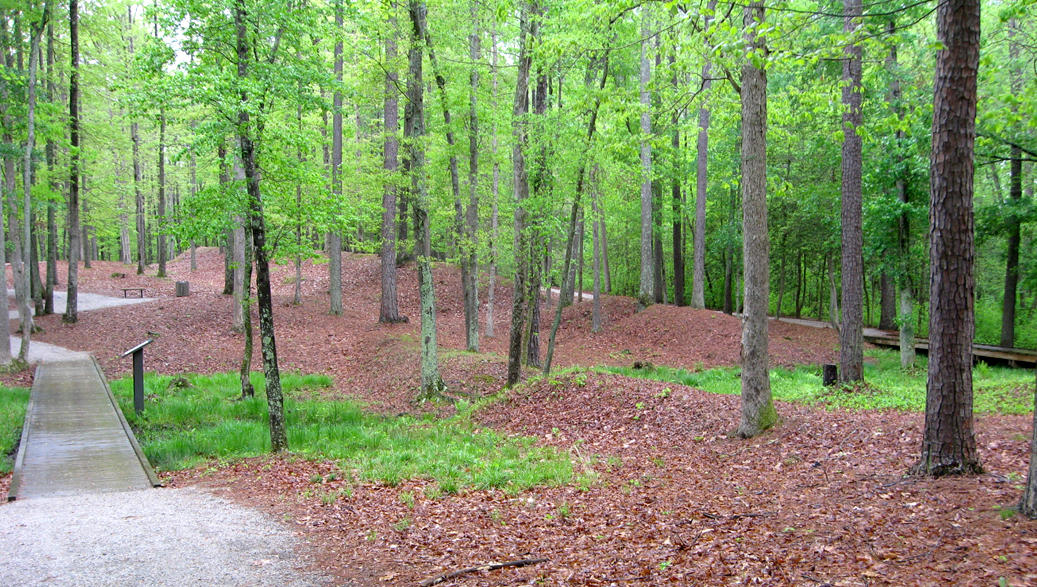
Confederate earthworks are still well preserved after 160 years.
About the Breakthrough Battle
Background – Grant’s First Assault
By June of 1864 Grant had pushed Lee back across Virginia in the Overland Campaign, fighting some of the bloodiest battles of the war. Lee was pressed into a well entrenched defensive line around Richmond. Grant hurled his men against those defences, a costly attack with little or no results. He decided to try another way.
Twenty miles to the south was Petersburg, a transportation hub where several roads and railroads came together, funneling into one road and railroad for the last 20 miles to Richmond. It also had fortifications, but they were almost unmanned. All the fighting troops were up at Richmond. Grant marched south, hoping to seize the hub and cut off almost all supplies to Richmond.
The plan almost worked. The first attack on June 15 overran the eastern line of fortifications. But as Confederate reinfocements arrived further attacks became very costly, with little results. Grant decided there would be no more frontal assaults, and settled down to a siege. He would surround the Confederates and starve them out.
The Longest Siege
Petersburg was not a true siege. The Confederates always had supply lines and a line of retreat until the very end. But over the next nine months Grant extended his lines little by little and closed the supply lines off one by one. Every time, the Confederates were forced to stretch their forces to counter. And Lee’s men – and the horses that carried their cavalry and pulled their artillery – were hungry and then starving over the winter. At the same time Grant’s men had plentiful supplies flowing down from the north by ship and distributed through the siege lines by a railroad their engineers built.
Grant made his last flank move at the the end of March with Sheridan’s cavalry and the Fifth Corps. Lee countered by thinning his lines even more to send Pickett and a division of infantry with some cavalry beyond the end of his lines to Five Forks. The resulting battle was a Confederate disaster. Pickett’s force was defeated and scattered, while Sheridan had an open road to cut the last supply lines into Petersburg.
Grant judged the Confederate lines were now thinned to the breaking point. He outnumbered Lee and his army was well fed. It was time. He ordered an assault all along the line.
Breakthrough – The Third Battle of Petersburg
At 4:40 a.m, on the morning of April 2 a signal gun fired and the 14,000 men of the Union 6th Corps surged forward in a mile wide wedge formation, with the Vermont Brigade at the tip of the wedge. Making their way through the abatis and guiding along the side of a ravine under a heavy fire, a group of men following Captain Charles G. Gould of the 5th Vermont were the first to enter the Confederate works. He was immediately wounded three times, but surived.
Eight brigades of the Sixth Corps followed the 5th Vermont through the disintegrating Southern line. Seven turned to the left behind the Confederate works and swept away the defenders down to Hatcher’s Run. They then returned, throwing back a small Confederate counterattack and pushing on through open country towards Petersburg.
Lee ordered his men to abandon the Petersburg defensive lines, fall back across the Appomattox River and make their way west. He advised President Jefferson Davis to immediately evacuate Richmond. The long Petersburg Campaign was over, and the short Appomattox Campaign had begun.
Directions to Pamplin Park
Pamplin Park is about 2.5 miles southwest of Petersburg Virginia. Its entrance is off US Route 1 and within a short distance of Interstate 86.
- From Petersburg on I-86 take exit 63A. Exit onto US-1 (Boydton Plank Road). Continue on US-1 for 1.2 miles. Turn left into the entrance drive for the park. It is marked by a large sign.
- From the south on I-86 take Exit 61. Turn right briefly on US 460 (there is a “to US-1” marker). Get in the left lane and in about 500 feet turn left at the light onto US-1. The entrance drive to the park is 0.5 miles on the right.