
Battle of Monocacy • Tour the Battlefield • Monuments & Markers • Facts
The “Burning the Bridge” wayside marker is along the bank of the Monocacy river on a walking trail from the Gambrill Mill parking area, (see map below) The modern Urbana Pike truss bridge visible from the marker crosses the river near the site of the Civil War covered bridge. The ‘Fleeing for Their Lives’ wayside marker is a few feet away.
Note: this marker replaces an earlier marker with the same background image but a slightly different title and different text. The older marker is also shown for completeness.
Burning the Bridge (current marker)

The photo is of the original marker. The background painting is the same as the current one.
Text from the current marker:
Burning the Bridge
On July 9, 1864, a wooden covered bridge spanned the Monocacy River where you see the present-day Urbana Pike Bridge. The covered bridge provided easy movement for the Confederates, intent on speeding 15,000 troops with their horses, wagons, and artillery toward their objective, Washington, D.C. Union General Wallace ordered the bridge held “at all hazard.” Throughout the morning the Confederates advanced on the bridge, but a determined Union force held them back. By noon, Wallace decided to move his troops toward the Confederate threat at the Thomas farm, then ordered the bridge burned. Sheaves of wheat were gathered and ignited under the bridge’s roof; flames engulfed the structure destroying it.
[The covered bridge] had to go….I remember as if it were yesterday the struggle I had with myself to have the match applied….I gave the word and in a moment…the old crossing was in a whirl of flame and smoke.
Union Major General Lew Wallace
Burning of the Bridge (original marker)
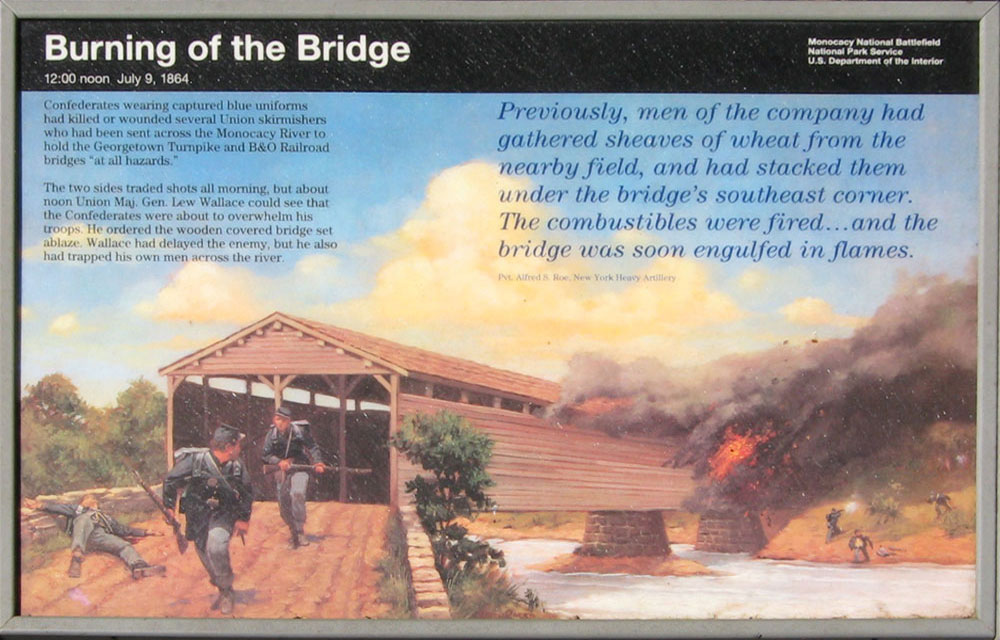
Text from the marker:
Burning of the Bridge
12:00 noon July 9, 1864
Confederates wearing captured blue uniforms had killed or wounded several Union skirmishers who had been sent across the Monocacy River to hold the Georgetown Turnpike and B&O Railroad bridges “at all hazards.”
The two sides traded shots all morning, but about noon Union Maj. Gen. Lew Wallace could see that the Confederates were about to overwhelm his troops. He ordered the wooden covered bridge set ablaze. Wallace had delayed the enemy, but he also had trapped his own men across the river.
Previously, men of the company had gathered sheaves of wheat from the nearby field, and had stacked them under the bridge’s southeast corner. The combustibles were fired …and the bridge was soon engulfed in flames.
Pvt. Alfred S. Roe, New York Heavy Artillery
Location of the marker
The “Fleeing for Their Lives” and “Burning the Bridge “markers are about 275 yards along a walking path whose trailhead is in the Gambrill Mill parking area. (39°22’09.2″N 77°23’17.6″W) Gambrill Mill is located just off the Urbana Pike (Maryland Route 355) opposite Araby Church Road, about 0.9 mile south of the National Park Visitor Center.