
Battles of Manassas • Tour the Battlefield • The Armies
The marker for Colonel James Cameron is near the Henry House on the Henry Hill walking tour. Cameron, the younger brother of Simon Cameron, Lincoln’s Secretary of War, was the Colonel of the 79th New York Infantry Regiment. He was killed by a shot to the chest while trying to rally his regiment, the first Union Colonel to be killed in the Civil War.
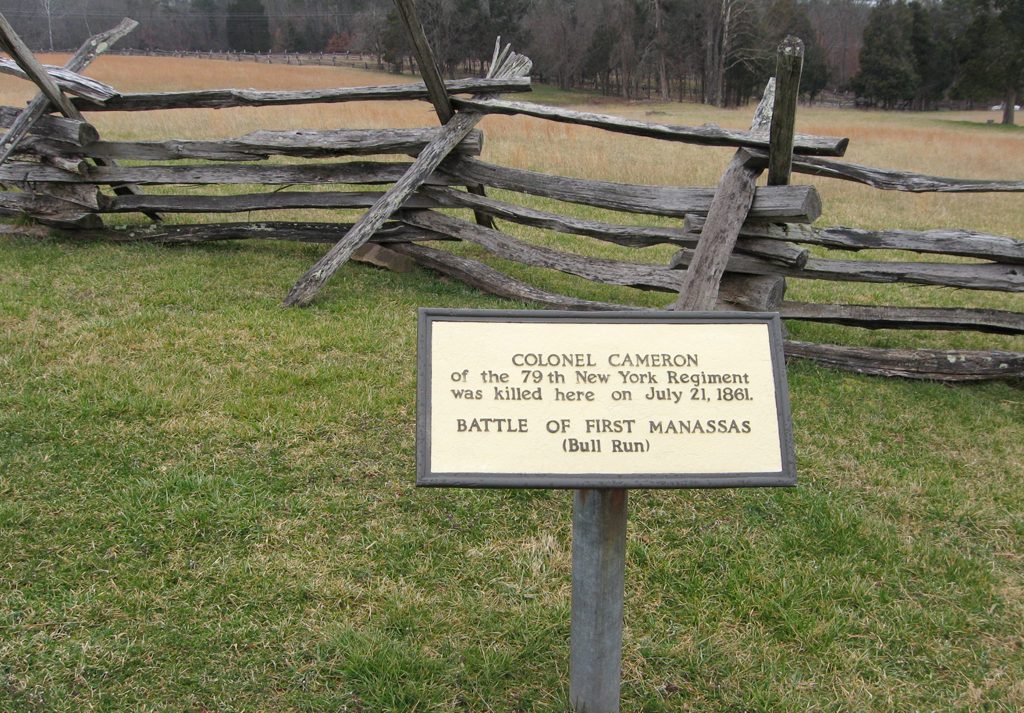
Text from the marker:
Colonel Cameron
of the 79th New York Regiment
was killed here on July 21, 1861.
Battle of First Manassas
(Bull Run)
About James Cameron
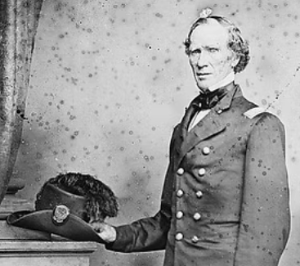
James Cameron was born in Lancaster County, Pennsylvania in 1800. His father died when he was young and he and Simon Cameron, his older brother by one year, went to work at an early age. Starting at age 19 James worked for and published several newspapers while he read law with future President James Buchanan. Cameron became a lawyer in 1829, the same year he married a widow, Rebecca Galbraith. For the next 15 years he practiced law while becoming superintendent of motive power on the Columbia & Philadelphia Railroad and deputy attorney general in Lancaster, Pennsylvania. He bought a farm in Milton in 1841.
With the coming of the Mexican War in 1846 Cameron became a sutler in New Orleans for Pennsylvania troops. He was later appointed Colonel in the Pennsylvania militia. Cameron returned to Pennsylvania after the war and resumed his law practice. In 1851 he moved to his farm in Milton while becoming an official with the Northern Central Railroad at their headquarters in nearby Sunbury. In 1856 he ran for Congress but was defeated. His brother Simon, however, had become the United States Senator from Pennsylvania for a second term.
Colonel of the 79th New York
When the Civil War broke out James Cameron, aged 61, headed to Washington, seeking to serve. The 79th New York Infantry had arrived in Washington without a colonel. The regiment’s original cadre of militia companies consisted of men of Scottish ancestry, were known as the “Highlanders,” and wore an adaptation of Scottish uniform. Simon Cameron was now Lincoln’s Secretary of War, and recommended his brother for the position (fitting, as Britain’s 79th Regiment of Foot were known as the Cameron Highlanders). James was appointed Colonel on June 20, 1861.
Cameron at Bull Run
A month later Colonel James Cameron was leading the 79th New York at the Battle of Manassas shouting, “Come on, my brave Highlanders!” The were attacking up Henry House Hill against the Confederates of Wade Hampton’s Legion (Wade Hampton also has a marker on the battlefield), attempting to reclaim the two Union artillery batteries that had been overrun. Halfway up the hill they were “staggered” by a volley from Hampton’s men. The regiment fell back in confusion and Cameron worked to rally and reform them, although Hampton supposedly said: “Isn’t it terrible to see that brave officer trying to lead his men forward and they won’t follow him?” The 79th launched a second attack but were again hit by a deadly volley. This time Cameron was struck in the chest, collapsed and bled to death in seconds.
Cameron’s body was taken to an ambulance in the rear. The driver at first refused to take him, wanting to keep the ambulance free for the wounded, but agreed when he was told who it was. However, during the collapse and retreat of the Union army the Confederates captured the ambulances. They removed the Union dead and wounded and used the ambulances for their own wounded. A flag of truce at the end of the battle to retrieve the body was refused. The bodies lay several days under the hot sun, until finally Cameron was buried in a mass grave with other Union casualties.
Bringing Cameron’s body home
Eight months later Union troops occupied the battlefield. Colonel Cameron’s former Adjutant, Sergeant John Kane, found a slave who had buried the bodies and had made a mental note of where the high ranking officer was. Cameron’s body was identified by the buckskin shirt he had been wearing and by a miniature of his wife he had. His remains were taken back north and interred in the Lewisburg Cemetery in Lewisburg, Pennsylvania
Location of the marker
The marker is about 250 yards north of the Visitor Center on the Henry Hill walking tour, about 30 yards southwest of the Henry House.