
Pamplin Park • Breakthrough Trail • Tudor Hall • Fortifications • Markers • Timeline
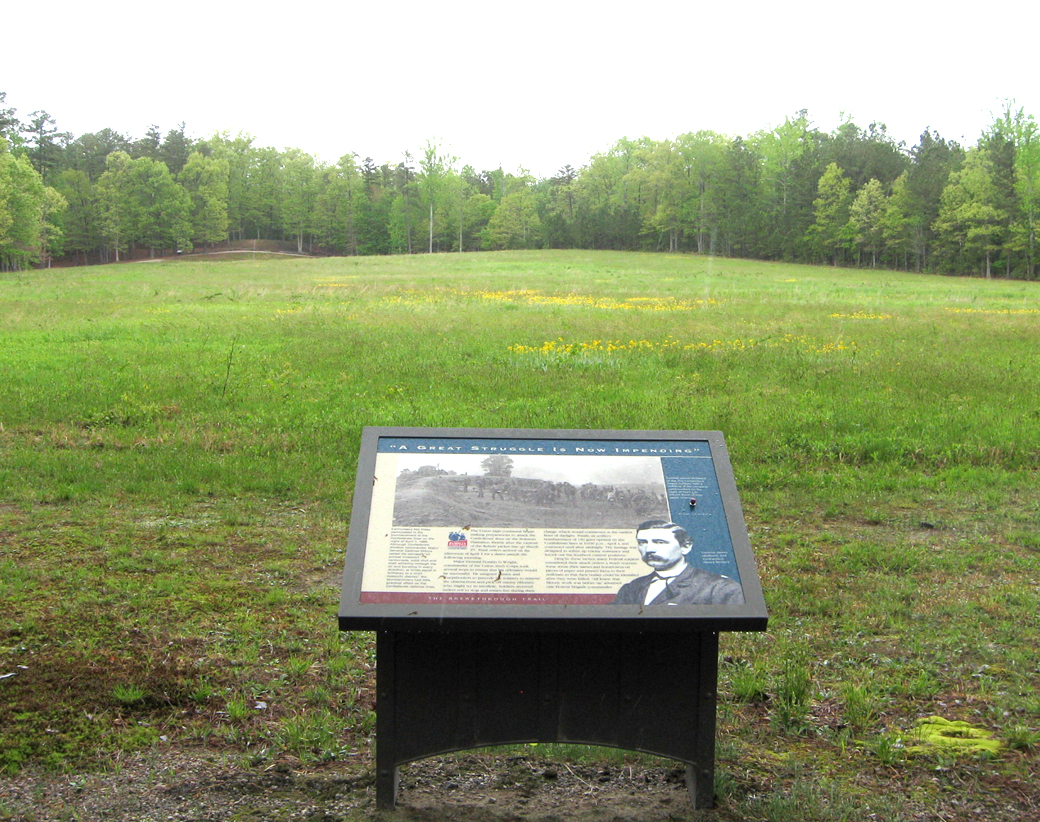
The Union attack crossed this open field to reach the Confederate lines, almost hidden today in the tree line. In 1864 the trees had all been cut down to build fortifications.
Text from the marker
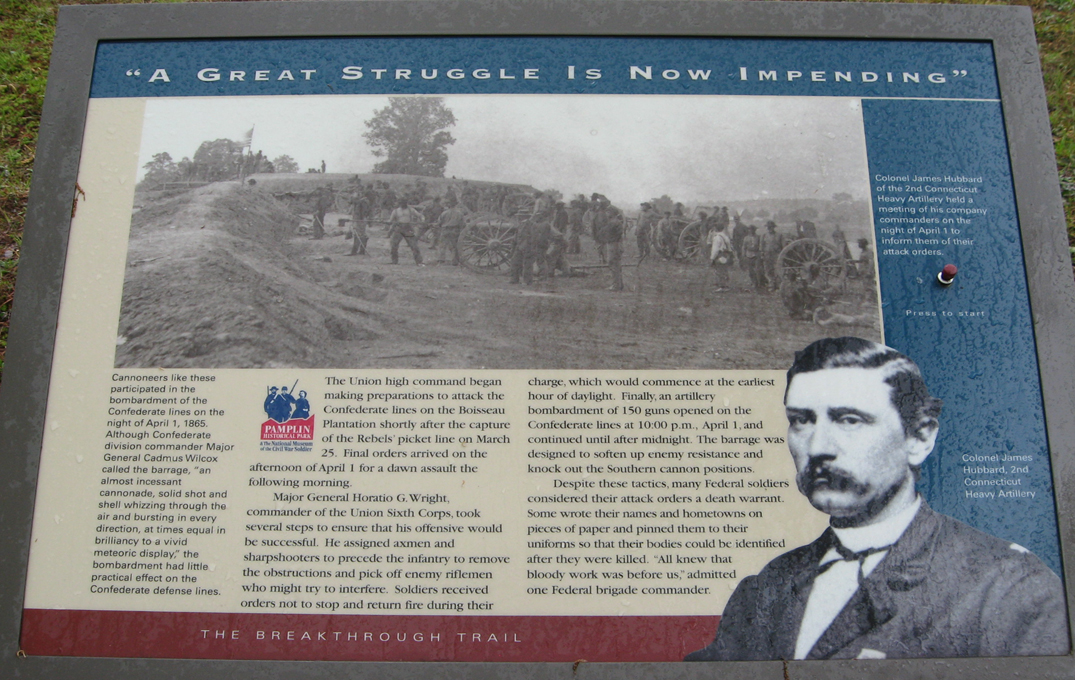
A Great Struggle Is Now Impending
The Union high command began making preparations to attack the Confederate lines on the Boisseau Plantation shortly after the capture of the Rebels’ picket line on March 25. Final orders arrived on the afternoon of April 1 for a dawn assault the following morning.
Major General Horatio G. Wright, commander of the Union Sixth Corps, took several steps to ensure that his offensive would be successful. He assigned axmen and sharpshooters to precede the infantry to remove the obstructions and pickoff enemy riflemen who might try to interfere. Soldiers received orders not to stop and return fire during their charge, which would commence at the earliest hour of daylight. Finally, an artillery bombardment of 150 guns opened on the Confederate lines at 10:00 p.m., April 1, and continued until after midnight. The barrage was designed to soften up enemy resistance and knock out the southern cannon positions.
Despite these tactics, many Federal soldiers considered their attack orders a death warrant. Some wrote their names and hometowns on pieces of paper and pinned them to their uniforms so that their bodies could be identified after they were killed. “All knew that bloody work was before us” admitted one Federal commander.
Caption to the main background photo
Cannoneers like these participated in the bombardment of the Confederate lines on the night of April 1, 1865. Although Confederate division commander Major General Cadmus Wilcox called the barrage ‘an almost incessant cannonade, solid shot and shell whizzing through the air and bursting in every direction, at times equal in brilliancy to a vivid meteoric display,’ the bombardment had little practical effect on the Confederate defense lines.”
Caption to the photo
Colonel James Hubbard, 2nd Connecticut Heavy Artillery.
Location of the marker
The A Great Struggle Is Now Impending wayside marker is on the Breakthrough trail at Pamplin Historical Park near Petersburg, Virginia. (37° 10.86′ N, 77° 28.194′ W)