
Pamplin Park • Breakthrough Trail • Tudor Hall • Fortifications • Markers • Timeline
Text from the marker
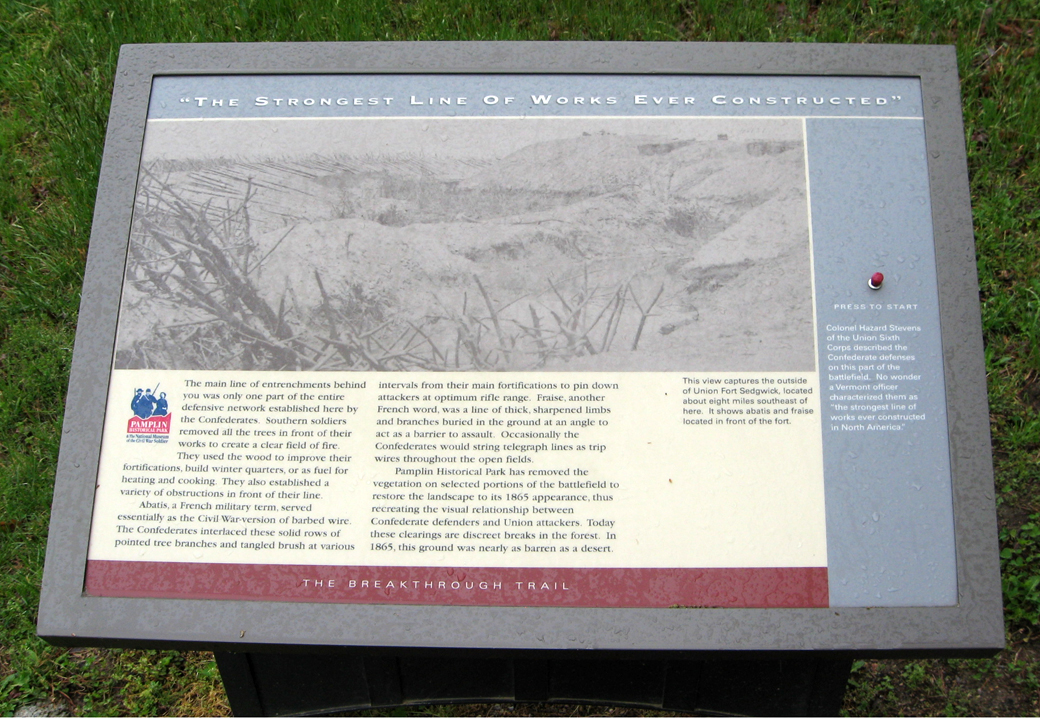
Strongest Line of Works Ever Constructed
The main line of entrenchments behind you was only one part of the entire defensive network established here by the Confederates. Southern soldiers removed all the trees in front of their works to create a clear field of fire. They used the wood to improve their fortifications, build winter quarters, or as fuel for heating and cooking. They also established a variety of obstructions in front of their lines.
Abatis, a French military term, served essentially as the Civil War-version of barbed wire. The Confederates interlaced these solid rows of pointed tree branches and tangled brush at various intervals from their main fortifications to pin down attackers at optimum rifle range. Fraise, another French word, was a line of thick, sharpened limbs and branches buried in the ground at an angle to act as a barrier to assault. Occasionally the Confederates would string telegraph lines as trip wires throughout the open fields.
Pamplin Historical Park has removed the vegetation on selected portions of the battlefield to restore the landscape to its 1865 appearance, thus recreating the visual relationship between Confederate defenders and Union attackers. Today these clearings are discreet breaks in the forest. In 1865, this ground was nearly as barren as a desert.
Caption to the photo
This view captures the outside of Union Fort Sedgwick, located about eight miles southeast of here. It shows abatis and fraise located in front of the fort.
Sidebar on the right
Colonel Hazard Stevens of the Union Sixth Corps described the Confederate defenses on this part of the battlefield. No wonder a Vermont officer characterized them as “the strongest line of works ever constructed in North America.”
Location of the marker
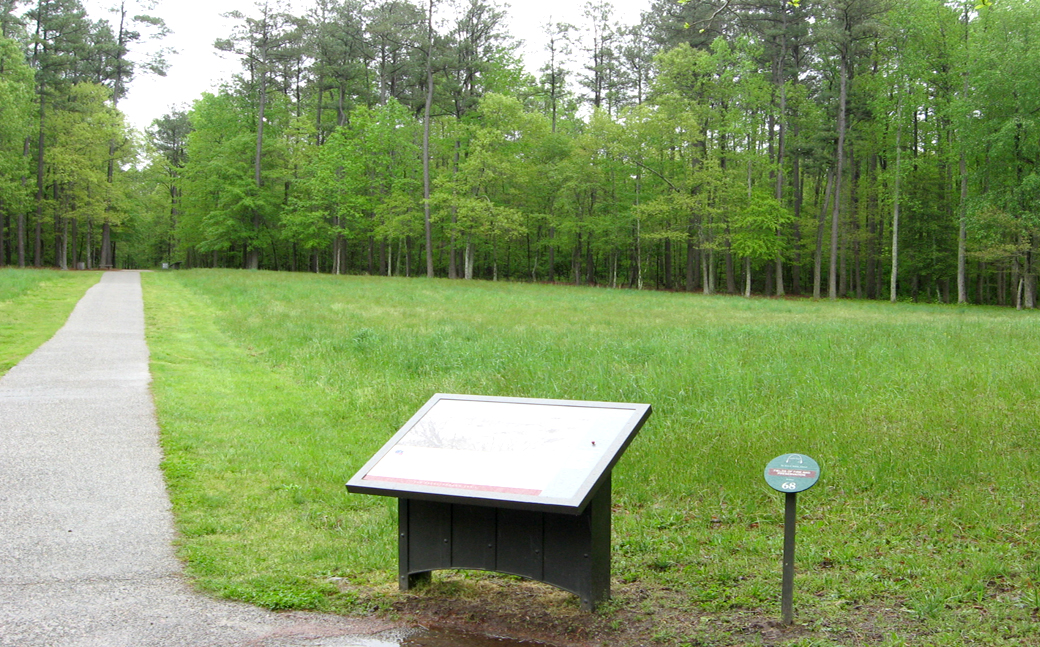
The Strongest Line of Works Ever Constructed is on the Breakthrough trail at Pamplin Historical Park near Petersburg, Virginia. (37° 10.785′ N, 77° 28.49′ W)