
The Battle of Fort Stevens was fought at its namesake fortification in the Defenses of Washington in 1864. It was only four miles from the White House on the north side of the District of Columbia. (see map below)
Today part of the fort has been reconstruced, rebuilt in the 1930s by the Civilian Conservation Corps. It is maintained by the National Park Service Civil War Defenses of Washington.
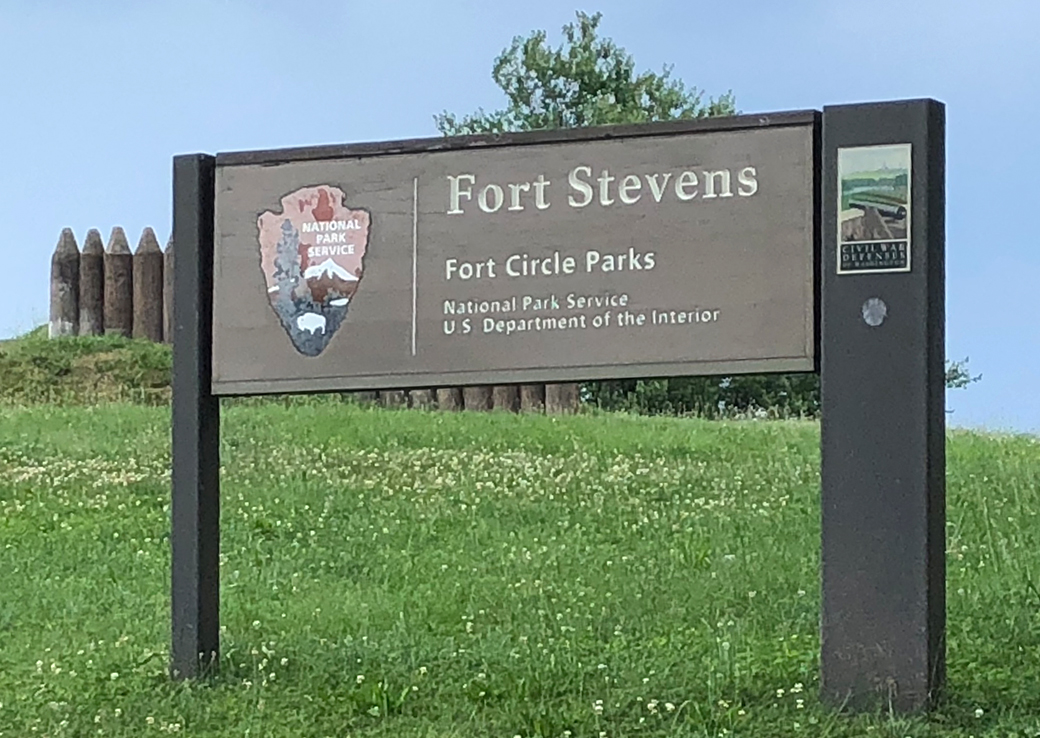
There are three Links in the menu to:
- About the Fort
- The Troops at the Battle
- Timetable of Early’s Raid on Washington
There are also four monuments and markers in the fort:
- Fort Stevens Orientation Marker
- Lincoln Under Fire Monument
- Fort Stevens wayside marker
- Scale Model of Fort Stevens
Background to the battle
By July of 1864 the main fighting in the Eastern Theater of the Civil War was in Virginia around Richmond and Petersburg. Grant’s army had ground across the state of Virginia all spring and summer in a series of battles that were brutally costly for both sides. Lee’s army was now compacted into strong defensive lines that circled around the two cities, and Grant’s progress had slowed to a crawl.
But Lee knew he was trapped. He still had an escapre route and supply lines still existed to the rest of the Confederacy. But abandoning the Confederate Capital would be a huge defeat. The Union had overwhelming numbers. They were slowly squeezing the supply lines shut. Unless things changed it was, in Lee’s own words, only a matter of time.
And so Lee, the ultimate gambler, ordered away almost a third of his army under Lieutenant General Jubal Early. He was to move west to the Shenendoah Valley and then cut north behind the cover of the Blue Ridge until he reached the Potomac. Then he was to dash east and threaten Washington D.C. His main goal was to disrupt the Union rear areas, draw Union troops away from Richmond and possibly buy enough time for the Northern elections to pull the rug out from under Lincoln and his failing, costly campaign. But if he took Washington it would be such a catastrophe for the Lincoln administration it could end the war.
The Defenses of Washington
Washington had been protected for most of the war by an inpenetrable circle of fortifications completely surrounding the city manned by a garrison of as many as 30,000 men. Even after Lee had badly beaten the Union forces after the Second Battle of Manassas (or Bull Run) in 1862 he never considered testing the Northern Capital’s defences, but turned aside to the eventual bloodbath at Antietam.
After Grant cornered Lee around Richmond he felt there was no need to keep 30,000 Union troops tied up far to the rear. He brought the garrison down to Richmond and Petersburg to make up for the Union’s heavy losses of the summer. Washington was left with many heavy fortress guns but as for men, only a handful of 90 day regiments, recovering wounded, and barely trained government clerks formed into a militia.
Lincoln’s high command still maintained the assumption that Washington could defend itself. This was true if it was only against raiding Confederate cavalry. But not against the hardened veterans of a third of Lee’s army. And to their horror, that’s what the Confederate raid that was surging out of the Shenendoah turned out to be. And by the time they realized the danger it was very near.
The march to Washington
While Early began to close in, the Union high command finally woke up and took action. Frantic messages were sent to Grant to send some of his troops by ship back to the capital. The militia of clerks manned the wall. But it seemed Grant’s help would never make it in time.
Stepping into the gap was Union Major General Lee Wallace. He had been banished to a rear area command around Baltimore for botching a troop movement under Grant at the Battle of Shiloh. Now he scraped together as many of his rear area troops as he could find and moved them to the river crossing of the Monocacy River east of Frederick. He was outnumbered at least 4 to 1, and his troops were completely inexperienced rear area garrisons, but he hoped to buy a little time. At the very last minute the first of Grant’s reinforcements, two veteran brigades of the Sixth Corps, landed at Baltimore. They were rushed by train to join Wallace on the Monocacy the night before Early’s Confederates moved onto the field. The Union men were still outnumbered 2 to 1, but at least it might be a fair fight rather than a complete disaster.
The Battle of Monocacy on July 9 was a Union defeat. But even outflanked and outnumbered, the dogged veterans of the Sixth Corps fought all day. They were finally forced off the field by late afternoon and fell back to Baltimore.
But Early had been delayed a day. His men were exhausted by the fight in the extremely hot and dusty weather. They still had 40 miles to march to reach Washington. And that night, responding to the news of Wallace’s defeat, Grant sent north the other two divisions of Major General Horatio Wright’s Sixth Corps, along with two divisions of the 19th Corps.
The Battle of Fort Stevens
Around Noon on July 11 Early’s dusty, exhaused men reached the edge of Washington. With much of his army spread out along the road behind him, he decided to hold off a full attack until the 12th. In the defenses, perhaps 9,600 untried reserves, recovering wounded, and new recruits waited, with a few hundred veterans of the 8th Illinois Cavalry in front of the walls. But at almost the same time, the first ships loaded with Grant’s reinforcements reached the docks south of the city.
By midafternoon Confederate skimishers advanced, probing the defenses. Confederate cavalry came up later in the afternoon and pushed through the skirmishers. But they were driven back by a counterattack. Skirmishing supported by Union artillery fire continued until nightfall. The rest of Early’s army made it to the battlefield, and prepared for an attack the next day.
But Grant’s reinforcements came up during the night.
Day two of the battle
Skirmishing resumed in the morning of July 12. The veterans of the Sixth Corps went out from behind the walls to meet them, and a deadly firefight broke out. It was probably at this time that President Lincoln came under fire while stepping up on the parapet to observe the action. The man next to him was struck, and he was told very sternly to get down. Eventually Early decided his chance had passed and he could not take Washington without crippling losses. Early withdrew that evening. About 400-500 Confederates became casualties in the battle, and 375 Union troops.
Early’s men crossed the Potomac back into Virginia on July 13, taking with them all the supplies they had collected in Maryland. It was a Union victory, but Early had accomplished his main objective by drawing away large numbers of Union forces from Richmond. As Early told one of his subordinates, “We didn’t take Washington but we scared Abe Lincoln like hell!” Now his mission was to keep them away from Richmond for as long as possible by leading them into the Shenendoah and tying them up for as long as he could.
Location of Fort Stevens
The fort is on the corner of 6001 13th St NW, Washington. This is the corner of 13th Street NW and Quackenbos Street NW, just one block west of Georgia Avenue N.W. (38°57’51.0″N 77°01’44.9″W)