
Petersburg • East • Southeast • West • Monuments • Markers • Facts • Timeline
 “The Crater” and “A Stupendous Failure” wayside markers are next to each other on the walking trail on the north side of The Crater at Stop Eight on the Petersburg Eastern Front Auto Tour.

“The Crater” (left) and “A Stupendous Failure” (right) wayside markers
The Crater wayside marker

Text from the marker:
The Crater
“There was utmost consternation. Some men scampered out of the lines; some, paralyzed with fear, vaguely scratched at the counterscarp as if trying to escape. Smoke and dust filled the air.”
– Col. William McMaster,
17th South Carolina Infantry
At 4:40 a.m. on July 30, 1864, the men of Captain Richard Pegram’s battery and two South Carolina regiments lay sleeping here at Elliot’s Salient. A moment later, this place turned into a smoking hole 170 feet long, 80 feet wide, and 30 feet deep. Two hundred and seventy-eight Confederates died in the blast. Two 1,700-pound cannons were hurled completely out of the works.
The depressions of four of the magazines (rooms that held the powder) exploded by Colonel Pleasants’s men are still visible inside the Crater.
Caption to the background drawing:
After the battle on July 30, the Confederates incorporated the Crater into their earthworks. Years of erosion and the removal of 669 bodies from the Crater and surrounding fields in 1866 have altered the site’s appearance.
Caption to the inset photo on the left:
Since the 1860s the Crater has been a popular spot for tourists. This photo was taken in 1867. Note the skull at the bottom of the picture.
A Stupendous Failure wayside marker
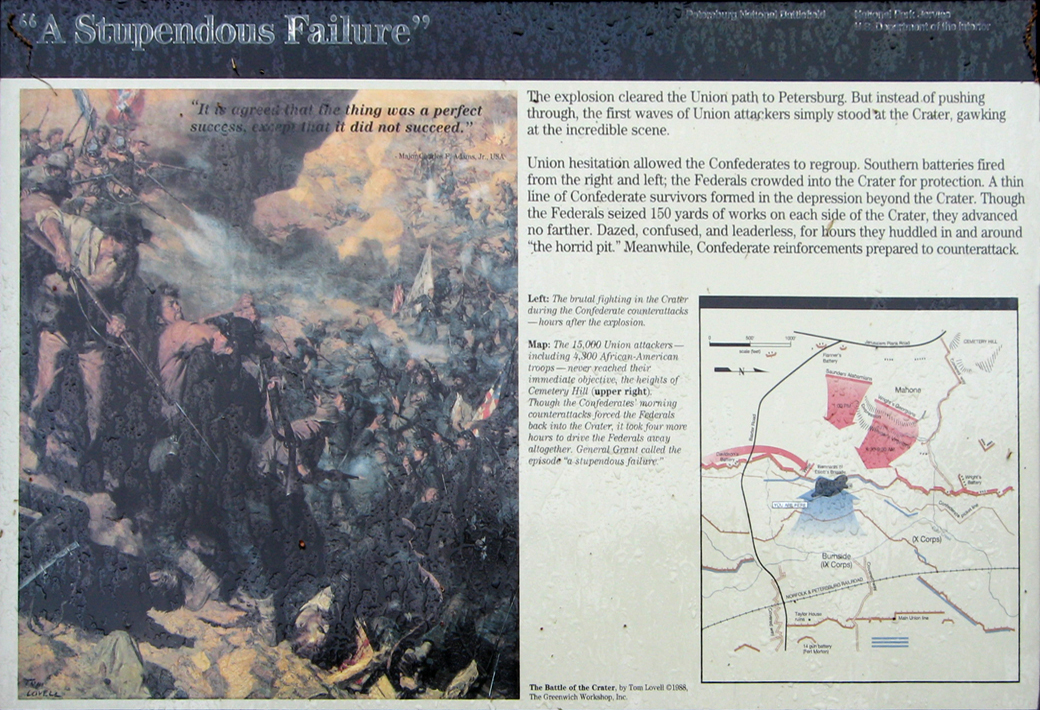
A Stupendous Failure
“It is agreed that the thing was a perfect success, except that it did not succeed.”
– Major Charles F. Adams, Jr., USA
The explosion cleared the Union path to Petersburg. But instead of pushing through, the first waves of Union attackers simply stood at the Crater, gawking at the incredible scene.
Union hesitation allowed the Confederates to regroup. Southern batteries fired from right and left; the Federals crowded into the Crater for protection. A thin line of Confederate survivors formed in the depression beyond the Crater. Though the Federals seized 150 yards of works on each side of the Crater, they advanced no farther. Dazed, confused, and leaderless, for hours they huddled in and around “the horrid pit.” Meanwhile, Confederate reinforcements prepared to counterattack.
Left: The brutal fighting in the Crater during the Confederate counterattacks – hours after the explosion.
Map: The 15,000 Union attackers – including 4,300 African-American troops – never reached their immediate objective, the heights of Cemetery Hill (upper right). Through the Confederates’ morning counterattacks forced the Federals back into the Crater, it took four more hours to drive the Federals away altogether. General Grant called the episode “a stupendous failure.”
Credit for the painting (at the bottom):
The Battle of the Crater ©Tom Lovell 1988,
The Greenwich Workshop, Inc.

Closeup of the map from the marker
Location of the markers
The markers are on the walking trail on the north side of The Crater. (37°13’06.8″N 77°22’39.0″W)